

The Experts Corner
The Invisible Details Behind Exceptional Cabins
From the first sketch to industrial reality, Sylvain Mariat ensures coherence across ACJ’s most bespoke cabin projects. He explains why trust, rigor, and design discipline are the real engines behind exceptional business-aviation interiors.
1. How would you describe your role at ACJ in a few words?
My role at ACJ is to ensure lasting coherence across our cabin design projects, bridging the gap between the initial creative intent and industrial reality. I operate at the intersection of design, engineering, and client expectations, with the goal of transforming a vision into an environment that is precise, functional, sustainable, and above all perfectly aligned with the end user’s desires.
2. What first drew you to aviation? Was it a childhood passion? And more specifically, what led you to business aviation?
I was drawn to aviation very early on as my father was a professional pilot of both airplanes and helicopters. I’ve always been fascinated by the industry's complexity and precision, even as a child, I was as interested in wing profiles and aerodynamic logic as I was in aesthetics. Business aviation eventually became the ideal playground for me, as it’s a unique space where high-level technical requirements meet a very direct, personal relationship with the final user.
3. Looking back at your career, which key milestone or experience has most shaped the way you work today?
Joining Airbus in 2004 was a defining moment. Working on major programs like the A380 and long-haul cabin interiors taught me the importance of industrial discipline and the power of collective effort. These two principles continue to structure my approach to work today.
4. What does a “good day” at ACJ look like for you? What makes you feel that real progress has been made?
A good day is often defined by invisible details: a resolved design choice on a seat’s silhouette, a seamless dialogue between teams, or finding a simple solution to a complex challenge, such as a table deployment mechanism. Progress, to me, is when a project advances quietly but with absolute structural integrity.
5. In your view, what truly differentiates ACJ from its competitors, beyond the strength of the Airbus brand?
Beyond the strength of the brand, ACJ stands out through its industrial culture applied to the bespoke. We bring the methodology, rigor, and long-term vision of commercial aviation and adapt them to unique, highly personalized projects.
6. Since joining ACJ, what changes have you observed in client expectations, whether in priorities, decision-making pace, or overall level of sophistication?
Clients today are more informed and deeply involved. They often possess a sophisticated understanding of design, influenced by luxury hotels and high-end residential architecture. They expect more than just personalization; they seek clarity, sustainability, and a flawless mastery of complexity often within tighter timeframes.
7. When a deal comes down to a critical decision, which factor tends to be the most decisive: trust, timing, execution, or long-term vision?
Trust remains the cornerstone. It is built through consistency, transparency, and the proven ability to honor commitments over the long term.
8. What advice would you give to someone embarking on an ACJ project for the first time, whether as a client, representative, or partner?
I would advise them to view the project as a process rather than just a product. Taking the time to understand the technical and human stakes is the key to achieving a solution that is both right and enduring. This is how we approach our work, and it is consistently the path to a successful and satisfying outcome.
9. If you had to summarize your vision of the market and of ACJ over the next 2 to 3 years in 3 sentences, what would they be?
The latest survey commissioned by ACJ finds global organizations are increasing their use of business aviation to support international expansion strategies, and philanthropic missions. We've also noticed that business aviation is no longer the sole domain of top executives but broadening access beyond the c-suite. We can also highlight the willingness of most corporations surveyed to upgrade their aircraft toward new, more sustainable and larger aircraft."
10. When launching a new project or making an important decision, do you rely more on instinct or on analytical reasoning?
Analysis sets the framework and secures our choices. Instinct then steps in as a synthesis of experience, allowing us to refine and adjust. This is why the designer carries such a significant responsibility in every project to provide that final, intuitive layer of excellence.
11. Outside of aviation, what helps you maintain balance, whether a passion, a routine, a place, or a personal ritual?
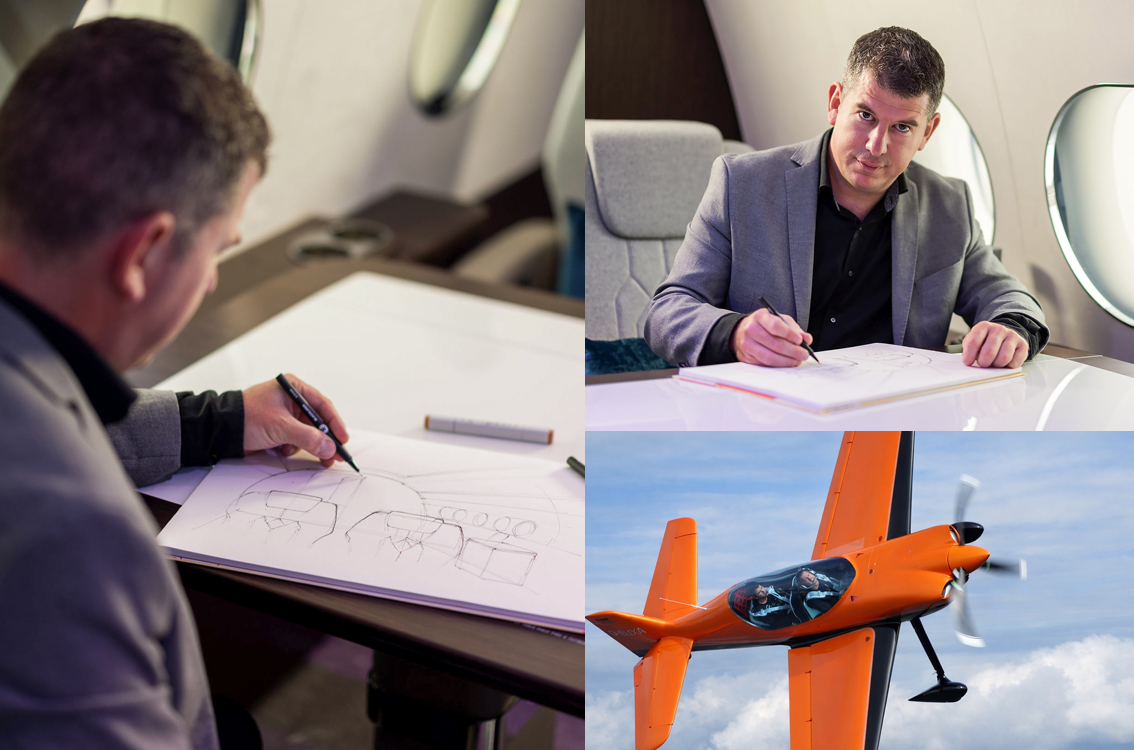
Hand-drawing and flying light aircraft in my spare time act as my 'oxygen.' These activities allow me to step back and maintain a sense of perspective. They are necessary moments of clarity that are essential when working in an industry as demanding as ours.