


An aviator, adventurer and humanitarian at heart, Gérard Feldzer has devoted his life to pushing the boundaries of aviation. From extraordinary flying adventures to humanitarian missions and environmental advocacy, he shares the experiences and convictions that have shaped his remarkable journey.
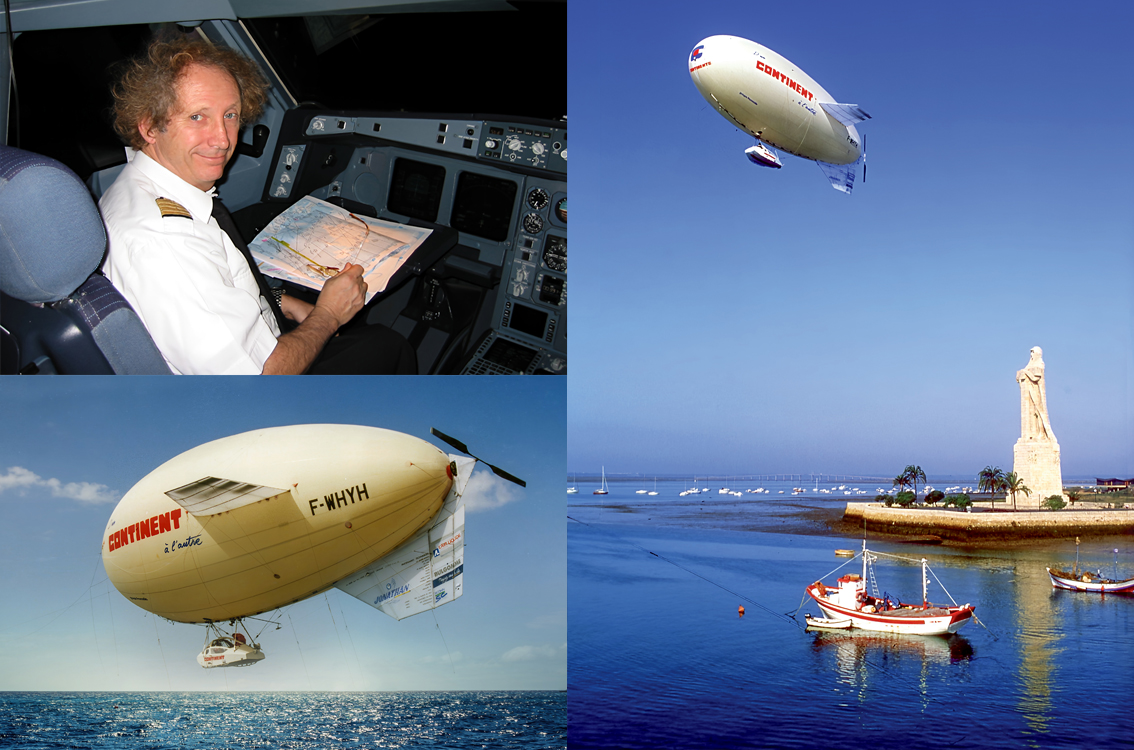
You have flown everything from Boeing 747s to humanitarian missions in Africa. What still brings the greatest emotion to a pilot like you today?
I have indeed flown quite a few aircraft, around a hundred different models. But light aviation, or what we call general aviation, deserves a great deal of respect. You are exposed to the elements, you are vulnerable, you have to take the weather into account, handle everything on board yourself, and you are on your own. You can even get lost while navigating, especially without GPS. And you have to remain humble, particularly when gliding, because you have to work with nature rather than against it. That is what makes it such an emotional experience.
When did you realise that aviation could also be a humanitarian tool, rather than simply a means of transport?
With Aviation Sans Frontières, we are directly responsible for our passengers and patients, so we have to be extremely careful. We wear two hats: caring for and reassuring people, while also supporting NGOs operating in remote areas, sometimes in dangerous circumstances. I realised that aviation could be a humanitarian tool, rather than simply a means of transport, during a visit to a refugee camp in Somalia, near the Ethiopian border. There, I witnessed a mother with two children, apparently twins, who had been forced to end the suffering of one in order to raise the other. When you witness something like that, life is never quite the same again. You feel compelled to take meaningful action and do even more to help those around us, wherever they may be in the world.
You have logged more than 10,000 flight hours. Is there one particular flight you have never forgotten?
Yes, I have 10,000 flight hours, but much of that time was spent on long-haul flights, operating large, robust aircraft. You are never flying alone; you consult your co-pilot. It is a completely different environment from light aviation. I started with Aéropostale, flying the Caravan. We would take off around 10 p.m. and arrive at 5 a.m. There was an incredible atmosphere, with memories of Saint-Exupéry and all those fellow aviators who took enormous risks in an era when aircraft were far less reliable. It really felt as though we were reliving the adventures of those pioneers. They were true heroes.
I operated some of the final flights of the Caravelle, a legendary aircraft developed after the war. I also flew the Boeing 707, the first long-range jet airliner, followed by the 747, which helped usher in a new era of air transport and inspired countless people to become pilots. My career eventually took me to the A330, with the emergence of digital technology and cockpit screens. As for unforgettable flights, there is one I would never want to experience again.
One day, a disturbed passenger entered the cockpit, seized the controls and shut down all four engines. It was an extremely dangerous situation, and we had to find solutions immediately. It was incredibly violent. He died in the cockpit. It was a deeply traumatic experience for me.
What truly sets Aviation Sans Frontières apart from a more conventional NGO?
What makes Aviation Sans Frontières different from a conventional NGO is the level of responsibility, adaptability and versatility required. You have to handle everything: negotiations, authorisations, maintenance, and above all, trust your mechanic. Human relationships are equally important. It requires a very wide range of skills. Compared with a more traditional NGO, our volunteers are extraordinarily motivated. Why? Because aviation is one big family. Saint-Exupéry captured that spirit beautifully in his novels. We are part of that tradition, and we continue to preserve it.
We have unsung heroes among our volunteers. Take the mechanics, for example. They work quietly behind the scenes, yet we entrust them with our lives every time we fly. We should never forget that.
I remember an incident in Congo when one of our aircraft became stuck in the mud. The propeller struck the ground, meaning both the engine and landing gear had to be replaced, in an incredibly remote location with no roads. The replacement engine had to be transported by canoe for four days. Our mechanics carried out the repairs and saved the aircraft.
You have spoken about missions in Somalia and Mozambique, where conditions were sometimes extreme. Have you ever been afraid during a mission?
During light aviation missions, back in the days before GPS, it could be genuinely frightening. When we flew supplies into refugee camps in Ethiopia, for example, the margin for error was considerable. You must always remain curious. It is a quality I insisted on in my pilots, because curiosity can save lives.
What does Aviation Sans Frontières need most today: pilots, mechanics, logistics, funding, or simply greater visibility?
At Aviation Sans Frontières, everything relies on a chain of solidarity. Some of our heroes are completely anonymous, and they fly desks rather than aircraft! And I do not mean that in a negative way. These are the people who prepare our files, look for funding and successfully secure it. As an NGO, we survive entirely through donations. That is absolutely essential. Everyone has a part to play, and together we form a wonderful family.
At Aviation Sans Frontières, we have needs, but we also have tremendous motivation. There is nothing more rewarding than helping to save children. Working with the NGO Mécénat Chirurgie Cardiaque, we arrange for children to undergo heart surgery and then bring them home healthy. The entire village is there to welcome them.
Experiences like these change the way you see the world. Some things matter, while others suddenly seem much less important. We are dealing with what truly matters: human lives. It is deeply moving. An NGO is about compassion, care and kindness. Of course, our greatest needs are financial. Operating an aircraft worth three million dollars, capable of landing in extreme conditions in remote villages where there are often no roads, is expensive.
It may sound costly, but recently, in Madagascar, we carried out medical consultations for approximately 6,000 people. When you break down the cost, it amounts to just a few cents per consultation, while helping to save lives. And that is priceless. We need around 1.5 million euros a year to acquire and equip an aircraft, recruit pilots and mechanics, and bring in doctors, who also volunteer their time. All of this requires financial resources. Ultimately, our funding determines how many people we can save.
Let me share a little story. Several years ago, when I travelled to Congo, the whole village was eagerly awaiting the arrival of our aircraft. In a remote settlement, there was a blind man whose condition placed a considerable burden on the village. He desperately wanted to touch the aircraft, even kiss it. The following day, a doctor operated on him and restored his sight. His words afterwards were extraordinary:
"I heard the aircraft arrive, and I saw it leave."
That is an extraordinary reward. It brings tears to your eyes.
You have long advocated for more sustainable aviation. What do you see as the biggest misconception in today's debate about aviation?
I am a bit of a contradiction: I love aviation, and I love the environment, especially a beautiful, unspoilt environment. We deserve better than being exposed to pollution every day. New technologies are making it possible to build increasingly lightweight aircraft. I strongly believe in biomimicry, learning from nature and particularly from birds, which fly far more efficiently than we do.
I occasionally fly alongside geese, close enough to stroke them. They look at you from just a few centimetres away while flying at 30 or 40 km/h. And I can almost imagine what they are thinking: "You really are rubbish at flying!"
We have so much to learn from them. Unfortunately, 15,000 species disappear every year, taking with them extraordinary natural adaptations that took millions of years to develop, knowledge we have barely begun to understand. It is a real shame.
The future of aviation begins with Sustainable Aviation Fuel. It is a synthetic fuel that does not require us to change aircraft engines. That is the first step. The idea is to achieve zero emissions by capturing carbon and producing hydrogen using renewable energy, then combining them to create synthetic kerosene. This synthetic fuel, in my view, offers the prospect of aviation without net CO₂ or greenhouse gas emissions.
I believe this is the way forward until we develop an aircraft based on a genuine technological breakthrough. After all, the last major technological revolution was Concorde, more than 50 years ago.
You have attempted some extraordinary adventures, including crossing the Atlantic in a pedal-powered airship with Nicolas Hulot. Looking back, was it madness or vision?
We always want to push ourselves further when pursuing our passions. You have to try to break a few records.
The idea of crossing the Atlantic in a pedal-powered balloon with Nicolas Hulot started out almost as a joke. We ended up pedalling for 2,500 kilometres. It was pretty crazy! We were just two days away from reaching our destination when, unfortunately, we crashed because of thunderstorms. That is life. That is nature. You have to adapt to it.
But we also left too late, and that was a major mistake. We should have taken advantage of the trade winds, which blow between December and January. Instead, we departed in March, so we knew we were taking risks. It ended badly, but it remains one of the most beautiful flights of my life. Humpback whales followed us, and we could hear the sound of the water they expelled as they surfaced. It was incredibly moving. Once again, there was this extraordinary connection with the animal world.
Your uncle, a fighter pilot, used to tell you, "If you can, go for it." Does that phrase still guide your life today?
My uncle was a fighter pilot and a guiding influence throughout my life. He still inspires me today. He told me how he had survived the Normandie-Niemen squadron, a fighter unit created through an agreement between de Gaulle and Stalin. De Gaulle proposed sending 250 fighter pilots to fight alongside the Russians against the Germans. My uncle, my father's brother, was among them. Something extraordinary happened to him. One day, flying a Yak, a Russian fighter aircraft, he shot down a Messerschmitt, a highly advanced German fighter. He watched the German pilot bail out and descend by parachute.
Although my uncle had been ordered to shoot down enemy pilots, he simply could not bring himself to do it. Instead, he flew close to the parachuting pilot, waved and said, "Good luck!" before flying away. But another German aircraft was following him. When the German pilot witnessed what had happened, he shot down my uncle's aircraft. His plane caught fire, and he was forced to bail out.
Instead of shooting at him, the German pilot returned exactly the same gesture, waving as my uncle had done moments earlier. I wrote a modest little book, nothing too serious, inspired by my uncle. It is called "Si tu peux, vas-y" — "If You Can, Go for It" — because that was the phrase he always had on his lips. He was an extraordinary man throughout his life.
You are a pilot, a science communicator, an activist and an entrepreneur. Have you ever felt that you were going against the current in the aviation world?
I feel out of step with a consumer-driven world where people take a flight simply because it costs €49 to go for a drink in Barcelona or Berlin. That is not the answer. We need a world that is not solely focused on consumption and finance. We should be striving for well-being.
I am against excessive consumerism, although I am also one of its victims. I own a foldable smartphone, for instance, and I know that is not exactly ideal! We need to consume in moderation. I hope we will see many more electric cars powered by wind and solar energy. Every rooftop should be fitted with solar panels. Electric aviation is also on its way. Batteries are becoming increasingly efficient. We will probably be flying fully electric 20-seat aircraft by 2027, using hydrogen fuel-cell technology.
Decarbonised aviation is possible. We simply need a technological breakthrough and manufacturers willing to lead the way, inspiring the rest of the industry to follow.
After spending your life in the skies, why did you choose to live on the water?
I wanted to live on a houseboat because it keeps me close to the natural elements. And after spending 30 years above the clouds, I simply could not imagine living between four walls, looking at photographs or watching myself grow old in the mirror. Water, like air, represents freedom.
Any final words?
To everyone who shares a passion for aviation, I would like to invite you to become donors and symbolic co-owners of a new aircraft, a CASA 212. It will be equipped with medical supplies, medicines and screening equipment for Ebola and other diseases. The aim is simple: to make the world a better place. Becoming a co-owner could mean contributing towards an aircraft tyre, a radio, or perhaps something more.
We will invite you to share these adventures with us through a small onboard camera broadcasting at a fixed time every day. You will be able to follow our missions as they unfold. We will give you a little wave from inside the aircraft, and you will become ambassadors for our work.
Do not hesitate to subscribe to the Aviation Sans Frontières newsletter to follow our adventures.
Thank you.